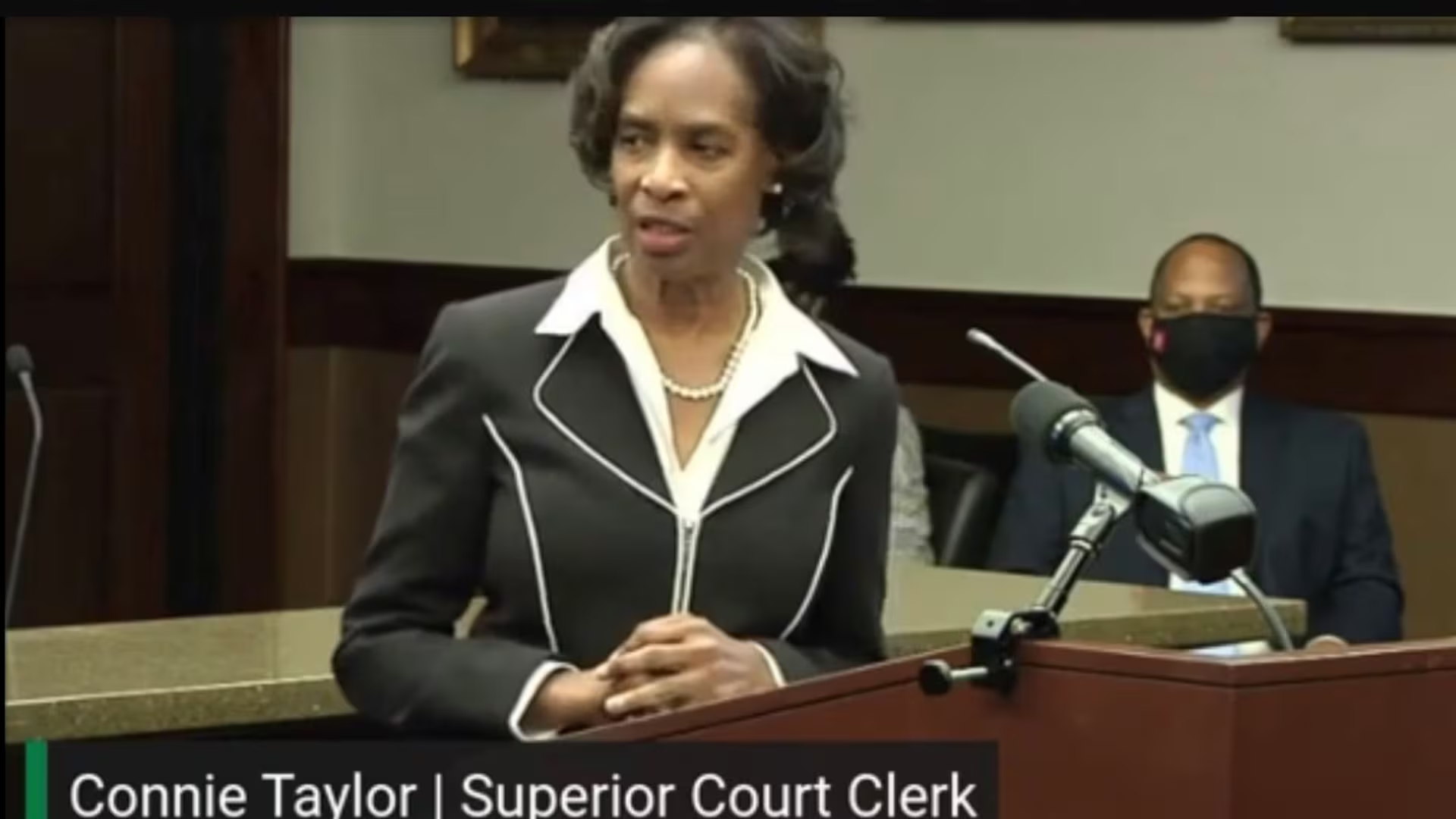
Comprehensive Investigative Brief
Case Status: Active prosecution – suspended from office without pay (August 29, 2025)
Current Charges: 7 felony counts (as of January 2026 reindictment)
- 2 counts: Destruction of Public Records
- 2 counts: Violation of Oath of Office
- 3 counts: Attempted Destruction of Public Records
Prosecutor: Georgia Attorney General Chris Carr (White Collar and Cyber Crime Unit)
Defense Counsel: Former Governor Roy Barnes, Craig Gillen, Anthony Lake
Case Origin: GBI investigation initiated November 16, 2022 at request of Cobb Superior Court Chief Judge
EXECUTIVE SUMMARY
Connie Taylor represents a case study in institutional capture and the systematic obstruction of transparency in Georgia’s county judicial system. Elected as Cobb County Superior Court Clerk in 2020, Taylor allegedly directed employee Maya Curry to destroy public records in response to an Atlanta Journal-Constitution Open Records request, telling her “We’re just going to Donald Trump this thing.” The records concerned Taylor’s collection of over $425,000 in passport fees as personal income—legal under Georgia law, but dramatically more than her predecessor had retained.
The case reveals three interconnected patterns: (1) exploitation of archaic Georgia statutes allowing clerks to pocket passport fees, (2) alleged destruction of evidence when transparency threatened personal financial gain, and (3) catastrophic administrative dysfunction that caused Chief Judge Gregory Poole to declare two judicial emergencies in 2024.
Cornbread Flag Assessment: High institutional dysfunction, evidence of obstruction of transparency mechanisms, retaliation against whistleblower, and sustained operational through judicial emergency period despite gross incompetence.
BACKGROUND DOSSIER
Personal Information
- Full Name: Connie Mae Taylor
- Age: 67 (as of 2025)
- Residence: Powder Springs, Cobb County, Georgia (21+ year resident)
- Education:
- Bachelor’s degree in International Business, American Inter-Continental University
- Master of Business Administration (MBA), American Inter-Continental University
- Religious Affiliation: Shaw Temple AME Zion Church, Smyrna, Georgia (15+ year member)
Professional Background
City of Atlanta Career (26+ years total):
- Grant Manager/Grants Compliance Director (26 years)
- Loan Program Manager, Bureau of Housing (3 years)
- Grant Accountant, Finance Department (2 years)
- Managed projects with budgets exceeding $100 million
Real Estate:
- Licensed real estate broker (Georgia and Florida)
- Licensed real estate instructor
Political Career:
- 2012: Candidate for Cobb County Commissioner (Southwest District) – Lost
- 2014: Candidate for Georgia House District 38 – Lost primary to incumbent David Wilkerson
- 2016: Candidate for Georgia House District 38 – Lost primary to incumbent David Wilkerson
- 2020: Elected Cobb County Superior Court Clerk (defeated Republican incumbent Rebecca Keaton)
- 2024: Re-elected with 54% of vote despite ongoing scandals (defeated Republican Deborah Dance)
Community Service/Appointments:
- President, Cobb Democratic Women
- Member at Large, Georgia Federation of Democratic Women
- Cobb County Board of Tax Assessors (appointed)
- SPLOST Oversight Committee (appointed by Commissioner Bob Thompson)
- Cobb County Parks Bond Advisory Committee
- Board Member, Arthur Langford Jr. Teen Leadership
- Associated with 25+ non-profit community organizations
THE PASSPORT FEE SCANDAL
The Financial Scheme
Legal Framework: Georgia law (archaic statute dating to when clerks in small offices had “meager salaries”) allows Superior Court Clerks to pocket the $35 passport processing fee as personal compensation. However, the $24.70 expedited shipping fee should go to the county.
Taylor’s Collection (2021-2022):
- Total passport fees retained: $425,000+
- Expedited shipping fees retained (illegally): $83,658.90
- FY 2021: $46,411.30
- FY 2022: $37,247.60
- Annual salary: $170,000
- Combined income: $595,000+ annually
Comparative Context:
- Predecessor Rebecca Keaton’s practice: Initially split 25% personal/75% office, then 50/50, eventually moving to 100% personal only near end of her term. Collected $116,731 over her entire 4-year term while returning $108,259 to county.
- Taylor’s approach: 100% retention from day one, including expedited fees that should have gone to county.
2017 ACCG Survey Context: Of 87 Georgia counties processing passports, 54 clerks/probate judges kept some or all fees as personal income. Examples:
- Cherokee County: $25 to county general fund, $10 to clerk support fund
- DeKalb/Gwinnett: $10 to county, $25 to clerk personally
- Taylor’s practice: $59.70 total (including illegal $24.70) to herself, $0 to county
THE MAYA CURRY WHISTLEBLOWER COMPLAINT
Timeline of Records Destruction Allegations
March 2022: Maya Curry hired as accounting manager for Clerk’s office
May 4, 2022: Curry emails Taylor asking how she wants to allocate passport fees, noting predecessor kept approximately half while forwarding rest to county. Taylor allegedly:
- Called Curry and “chastised” her for putting question in writing
- Told Curry not to send any more emails on the subject
- Instructed that all passport-related money should be sent to Taylor personally
- Said she was “waiting for guidance from the county” (County finance officials later stated they were unaware Taylor was keeping all fees)
- Told Curry the money was “her money”
October 11, 2022: Atlanta Journal-Constitution files Open Records Act request for documents detailing clerk’s office handling of passport application fees
October 13, 2022 – The “Donald Trump This Thing” Incident: Curry brought the Open Records request to Taylor’s attention. Taylor allegedly:
- Said she would not comply with the request
- Told Curry “We’re just going to Donald Trump this thing”
- Referenced the 2001 Enron scandal, stating “the accountants were held responsible alongside the executives”
- Discussed issuing only handwritten checks for passport fees going forward
- Ordered Curry to discontinue issuing passport fee checks under the office’s electronic AccuFund system
- Commanded Curry to access AccuFund and delete records of electronic checks issued to Taylor for passport fees
- Ordered Curry to delete a digital folder titled “Passport” containing accounting records
- Ordered Curry to delete email Curry had sent Taylor with subject line “Expedited Passport Revenue Analysis 2021-2022” containing attached financial report
Curry’s Response:
- Refused to delete the records
- Reported incident to her supervisor
- Uploaded records to backed-up digital drive to preserve evidence
- Prepared report showing county was owed $86,425 in shipping fees
Taylor’s Retaliation:
- Demanded Curry leave the office
- Terminated Curry’s access to office computer systems
- Sent Curry home
- November 17, 2022: Curry placed on administrative leave
November 17, 2022: Attorney Stacey Evans files whistleblower complaint on Curry’s behalf to Cobb County Board of Commissioners, warning county not to destroy evidence
November 18, 2022: Georgia Bureau of Investigation opens criminal probe at request of Cobb Superior Court Chief Judge
THE CRIMINAL PROSECUTION
Investigation Phase
- November 16, 2022: Chief Judge of Cobb Superior Court requests GBI investigation
- November 16, 2022 – March 14, 2024: GBI conducts investigation
- March 14, 2024: Completed GBI investigation turned over to Georgia Attorney General’s Office for prosecutorial review
- April 23, 2024: AG’s office confirms reviewing GBI findings
Initial Indictment (July 31, 2025)
Charges Filed:
- 2 counts: Destruction of Public Records (2-10 years each)
- 2 counts: Violation of Oath of Office (1-5 years each)
Specific Allegations:
- Count 1 & 3: Ordering deletion of “Passport” folder on Curry’s work computer containing accounting records (October 13, 2022)
- Count 2 & 4: Ordering deletion of email with subject “Expedited Passport Revenue Analysis 2021-2022” sent from Curry to Taylor containing financial report (October 13, 2022)
- Violating oath by directing deletion of records Taylor “had a duty to keep with care and security”
Processing:
- August 1, 2025: Taylor booked into Cobb County Jail at 7:00 AM
- Released on own recognizance (signature bond) after 1 hour 20 minutes
- Paid $20 bond fee
- August 21, 2025: Governor Kemp appoints review commission per O.C.G.A. § 45-5-6(b)
- August 26, 2025: Commission finds indictment “does relate to and adversely affect the administration of the office”
- August 29, 2025: Governor Brian Kemp suspends Taylor from office without pay pending case resolution
- September 2025: Taylor waives formal arraignment, pleads not guilty
Defense Strategy
Defense team argued in November 2025 brief: “There is no allegation in the Indictment that the documents were in fact altered, corrupted and avoided — only that the Clerk told Maya Curry to do so. The documents were not in fact deleted, and therefore there can be no crime.”
Reindictment (January 2026)
New Charges Added:
- 3 additional counts: Attempted Destruction of Public Records
- Allegation: Taylor ordered Curry to delete records of checks payable to Taylor within AccuFund accounting software
- Charges allege Taylor “did take a substantial step towards the commission” of destroying records
Prosecution Response to Defense: The reindictment directly addresses defense argument that no crime occurred because records weren’t actually deleted. Attempted destruction charges establish that ordering deletion constitutes “substantial step towards commission” regardless of whether employee complied.
Current Status (February 2026):
- Trial delayed multiple times (originally October 2025, pushed to November, delayed again)
- Multiple pretrial motions pending, including defense motion to dismiss charges
- February 6, 2026: Hearing on pretrial motions delayed after defense requested more time following reindictment
Judicial Assignment:
- All Cobb Superior Court judges recused
- Senior Superior Court Judge William “Beau” McClain (retired Douglas County) assigned
- Cobb District Attorney’s Office recused – AG’s office has full prosecutorial authority
- 7th Judicial District appointed judge to preside
THE JUDICIAL EMERGENCY CRISIS
Background: The Catastrophic Software Conversion
Beyond the criminal charges, Taylor’s tenure as clerk has been marked by extraordinary operational dysfunction that threatened the entire Cobb County judicial system.
June 24, 2024: Taylor initiates conversion from CRIS (old case management system) to Icon (new system provided by Catalis) without notifying judges, attorneys, or defendants beforehand.
First Judicial Emergency (August 7, 2024)
Chief Judge A. Gregory Poole’s Declaration: “Significant disruptions” in Superior Court Clerk’s office have “so disrupted the functioning of the Court as to have substantially endangered or infringed upon the normal functioning of the judicial system.”
Critical Failures Documented:
Records Access:
- Severe disruption in access to records and critical court functions
- Documents not viewable in system
- Some documents dating back to November 2023 remained unindexed
- Backlog so severe it raised “serious due process and other constitutional concerns”
Notification Failures:
- Notices never delivered
- Unprecedented number of no-shows before bench
- Hearing notices not sent to parties
- Scheduling and calendaring failures
Filing Disruptions:
- Several days where no court documents could be electronically filed
- Delays of 60+ days on court filings (since at least December 2023)
- Attorneys forced to use alternative filing system (Peach Court, a paid program)
- Some attorneys filing directly with individual judges to circumvent clerk’s office
Law Enforcement Impact:
- Police unable to locate bench warrants and protective orders in Superior Court system
- Officers unable to enforce protective orders unless petitioner provided physical copy
- Sgt. Eric Smith (Cobb County Police): Officers could only act if petitioner showed them original copy
Additional Failures:
- Clerk’s office stopped publishing legally required notices in county legal organ (Marietta Daily Journal)
- Court reporters had difficulty obtaining evidence held by clerk needed to complete transcripts
- Stamp-filing procedural changes confused court staff
- Indigent defendants still being charged for document access
Order Effects: Suspended filing deadlines and administrative requirements in civil and criminal cases, including:
- Motions for new trials
- Service of parties requirements
- Answering civil cases
- Filing appeals
- Various other court proceedings
Judge Poole’s Assessment: “These issues are ‘not the result of a computer glitch.’ Cobb County’s court system was once a model for the entire state—a well-oiled machine. But under Taylor’s watch, it’s become an embarrassment. Cobb County is now an example, but not the kind anyone would want to follow.”
Extension of Emergency (August 28, 2024)
30-day extension through October 6, 2024 due to:
- Continued significant backlog
- Unindexed documents dating to November 2023
- Ongoing issues with noticing, scheduling, calendaring
- Persistent problems listed in initial declaration
Staffing Crisis:
- Vacancy rate: 38% (43 vacancies out of 107 positions)
- January 2021 – August 2024 turnover:
- Hired: 103 employees (109 per some sources)
- Lost: 110-111 employees
- 75 resignations
- 13 retirements
- 23 firings
Judge Poole on Leadership: “I think that there have been so many people that have been fired and who have left because of the working conditions, it just makes it very difficult to work for that office, and everyone in the courthouse knows it. There’s no way around it. It is a leadership issue.”
Catalis Response: Company stated it had gone “above and beyond its contractual obligations” by assigning 12 employees to help Taylor’s office move documents from old system to Icon.
Emergency Lifted (October 6, 2024)
Judge Poole’s Statement: “Though the Chief Judge remains concerned about other issues arising within the Clerk’s Office, he is comfortable allowing the Judicial Emergency to expire.”
Poole appreciated clerk’s office diligence in working through backlog issue but expressed ongoing concerns about other problems.
Legal Community Assessment
2024 Cobb Bar Association Survey:
- 60% of attorneys rated their experience with Taylor’s office as “poor”
- Unprecedented criticism from bench
- Judges openly criticizing clerk’s office performance
Former County Attorney Deborah Dance (2024 Republican challenger): “I think it’s time to restore the superior court clerk’s office to the premier office that it was prior to the current administration. The clerk should be accountable to the public, available to the public, responsive and responsible.”
FINANCIAL IRREGULARITIES & REIMBURSEMENT
The Delayed Repayment Saga
November 2022: Taylor initially agrees to repay $83,658.90 in expedited shipping fees, citing “error” in “obsolete system” discovered during “internal audit”
November 17, 2022: Item scheduled for Cobb County Board of Commissioners vote – Taylor withdraws measure from agenda without warning same day, immediately after Curry files whistleblower complaint
February 2025: Taylor finally reimburses Cobb County $83,658.90 – more than two years after initial commitment, never explaining the delay
2023-2024 Additional Payments:
- Already returned $43,750 for expedited passport fees collected in 2023 and 2024
- Taylor stopped collecting passport fees entirely in October 2022 after scandal broke
Legislative Response
Senate Bill 19 (2024) – Sen. Kay Kirkpatrick (R-Marietta):
- Original intent: Ban practice of clerks pocketing passport fees entirely
- Actual passage: Watered down version requiring quarterly disclosure
- Current requirement: Superior court clerks must submit quarterly reports of passport fees collected to county commission
Association County Commissioners of Georgia Position: Todd Edwards, Deputy Legislative Director: “This should be alarming to the taxpayers. It’s double-dipping on county time. The law that allows this is a holdover from long-ago when clerks in small offices augmented their meager salaries with these fees.”
DEFENSE TEAM PROFILE
Roy Barnes – Lead Defense Counsel
Background:
- Former Governor of Georgia (Democrat, 1999-2003)
- Lost 2002 re-election to Republican Sonny Perdue in upset
- Prominent Atlanta attorney
- Known for taking high-profile political defense cases
Campaign Finance Connection:
- Barnes Law Group donated $3,300 to Taylor’s 2024 re-election campaign
- Taylor raised $20,600 total by June 30, 2024 deadline
- Outpaced Republican challenger Deborah Dance ($10,550 raised, $4,400 self-loaned)
Other Defense Team Members:
- Craig Gillen
- Anthony Lake
Defense Posture:
- No public comments from Barnes or team
- Declined all media requests for comment
- Strategy focused on arguing records weren’t actually destroyed, therefore no crime occurred
- Prosecution’s reindictment with attempted destruction charges directly counters this defense
COBB COUNTY INSTITUTIONAL CONTEXT
Constitutional Officer Status
Critical Jurisdictional Point: As a state constitutional officer, Taylor operates independently and is not under direct authority of Cobb County Board of Commissioners.
Implications:
- County commissioners set clerk’s budget but Taylor authorized to allocate funds as she sees fit
- County commissioners cannot suspend, hire, or fire employees in clerk’s office
- County has limited oversight despite Taylor being paid by county taxpayers
- County’s official position: “We respect the judicial process and will allow it to run its course”
Systemic Accountability Gaps
Recusal Pattern:
- All Cobb Superior Court judges recused from case
- Cobb District Attorney Flynn Broady’s office recused
- Outside judge (Senior Judge William “Beau” McClain from Douglas County) assigned
- Georgia Attorney General’s office conducting prosecution
Historical Context: This recusal pattern mirrors accountability challenges seen in other Georgia counties where local officials cannot effectively investigate/prosecute fellow local officials, requiring state-level intervention.
POLITICAL SURVIVAL DESPITE SCANDAL
2024 Re-election Campaign
Primary Challenges (May 21, 2024): Taylor faced three Democratic challengers:
- Carole Melton (raised $16,700)
- Brunessa Drayton (raised $11,600)
- Nick Simpson (raised $9,000)
Taylor won primary despite:
- Ongoing GBI/AG investigation
- Whistleblower allegations public since November 2022
- Judicial emergency declared in August 2024
General Election (November 2024):
- Taylor (D): 54% of vote
- Deborah Dance (R): 46%
Dance Background:
- Former Cobb County Attorney (25 years in Cobb judicial system)
- Drew bipartisan support from legal community
- Notable donors included:
- Commissioner JoAnn Birrell ($250)
- State Sen. Kay Kirkpatrick ($250)
- Former Cobb Superior Court Judge Tain Kell and wife Sheri ($200)
- Former Cobb Superior Court Clerk Jay Stephenson ($200)
- Former Cobb Transportation Director Faye DiMassimo ($500)
- Kennesaw City Attorney Randall Bentley ($500)
- Cobb GOP ($250)
Why Did Taylor Win?
Partisan Lean: Cobb County has trended Democratic in recent elections. Down-ballot Democratic candidates often benefit from straight-ticket voting regardless of individual scandals.
Name Recognition: Taylor had:
- Prior runs for Georgia House (2014, 2016)
- Run for County Commissioner (2012)
- Multiple community organization affiliations
- Established political network through Cobb Democratic Women leadership
Timing:
- Criminal indictment came July 31, 2025 – after her re-election in November 2024
- GBI investigation not completed/presented until March 2024
- During 2024 campaign, charges had not yet been filed
Low Information Voters: Superior Court Clerk is administrative down-ballot race that typically receives minimal voter attention. Many voters may have been unaware of scandals or ongoing investigation.
CORNBREAD FLAG FRAMEWORK ANALYSIS
Institutional Fear Indicators (Score: 4/5)
Present:
- Whistleblower Maya Curry fired/placed on leave after reporting illegal conduct
- Chief Judge required to declare judicial emergency – extraordinary intervention
- All local judges/DA recused themselves from case
- Stacey Evans’ letter explicitly warning county against destroying evidence involving Curry
- Culture of fear documented by 38% vacancy rate and massive turnover
Pattern: Employees who question Taylor’s practices face retaliation. Maya Curry’s experience—being “chastised” for asking questions in writing, having computer access revoked, being sent home—demonstrates clear pattern of intimidation.
Network/Family Connections (Score: 2/5)
Present:
- Former Governor Roy Barnes as defense counsel (political network connection)
- Barnes Law Group campaign donation during prosecution
- Democratic Party institutional support network maintained through re-election despite scandal
- Community organization network used for political survival
Notable Absence: Unlike classic Dixie Mafia cases, no clear evidence of multi-generational family networks or connections to historical organized crime. Taylor’s connections are primarily political/partisan rather than criminal-organizational.
Geographic Markers (Score: 2/5)
Present:
- Cobb County location (part of metro Atlanta, not rural Appalachian moonshine territory)
- Southwest Cobb County residence (Powder Springs) – area Taylor repeatedly tried to represent politically
Distinction from Classic Pattern: This is suburban/metropolitan corruption, not rural Appalachian. Different cultural and institutional context from classic Dixie Mafia operations in northeast Georgia.
Legal/Procedural Anomalies (Score: 5/5)
Present:
- Exploitation of archaic statute allowing personal retention of passport fees (relic from “small office” era)
- Records destruction ordered in response to Open Records request (direct obstruction of transparency)
- Constitutional officer status creates accountability gap where county commissioners lack authority
- Required state-level intervention (AG prosecution, outside judge)
- Delayed reimbursement without explanation (November 2022 promise, February 2025 payment)
- Ability to continue collecting fees despite investigation (stopped October 2022 only after scandal broke)
- Re-election despite ongoing criminal investigation
- Continued service from July 2025 indictment through August 2025 suspension
Critical Pattern: Legal framework created opportunity for enrichment, transparency mechanisms triggered obstruction, institutional structure prevented local accountability.
Financial/Benefit Irregularities (Score: 5/5)
Present:
- $425,000 in passport fees collected (2021-2022) on top of $170,000 salary = $595,000 annual income
- $83,658.90 in illegal expedited shipping fees
- Dramatic increase from predecessor’s practice (Keaton collected $116,731 over entire 4-year term)
- 100% retention rate versus predecessor’s graduated approach
- “Her money” mindset when questioned about fees
- Discussion of moving to handwritten checks to avoid digital records
Comparison Context: This is not mob-style extortion or racket. It’s exploitation of legal loopholes for personal financial gain combined with alleged obstruction when transparency threatened continued enrichment.
Operational Dysfunction (Score: 5/5)
Present:
- Two judicial emergencies declared – extraordinary intervention
- 38% vacancy rate (43 of 107 positions unfilled)
- Hired 103-109 employees, lost 110-111 (negative net staffing)
- Documents from November 2023 still unindexed 8 months later
- Police unable to access protective orders/warrants
- 60% of attorneys rate office as “poor”
- Software conversion catastrophe (no notice to judges/attorneys)
- Judge Poole: “not the result of a computer glitch” but leadership failure
- Attorneys forced to bypass clerk’s office, file directly with judges
Unique Pattern: This level of sustained operational failure while remaining in office is extraordinary. The judicial emergency mechanism exists for natural disasters, not administrative incompetence.
Duration/Timeline (Score: 3/5)
Present:
- Operation from January 2021 through August 2025 suspension = 4.5 years
- Passport fee scheme throughout entire tenure
- Operational failures documented from December 2023 (if not earlier)
- Investigation from November 2022 through ongoing prosecution = 3+ years without resolution
- Still receiving salary/benefits during investigation until August 2025 suspension
Context: Unlike Dixie Mafia operations that ran for decades, this is shorter duration but sustained through re-election and judicial emergency. Timeline reflects institutional protection (ability to run for re-election despite investigation) rather than classic criminal enterprise longevity.
TOTAL CORNBREAD FLAG SCORE: 26/35 (74%)
Assessment Category: High Institutional Dysfunction with Obstruction of Transparency
Comparative Analysis:
- Higher than typical isolated misconduct cases (would score 30-40%)
- Lower than multi-generational criminal enterprise cases (would score 85-95%)
- Similar to cases of entrenched political officials exploiting institutional gaps (65-80% range)
Distinguishing Features:
- Not organized crime in traditional sense
- Exploitation of legal frameworks rather than illegal rackets
- Alleged obstruction occurred when transparency threatened personal financial gain
- Institutional structure (constitutional officer status) prevented local accountability
- Political survival through partisan lean despite scandal
- Catastrophic operational failure tolerated through judicial emergency mechanism
KEY EVIDENTIARY DOCUMENTS
Available Through Open Records/Court Filings
- July 31, 2025 Initial Indictment – Cobb County Superior Court
- January 2026 Reindictment – Adding attempted destruction charges
- November 17, 2022 Whistleblower Letter – Stacey Evans to Cobb County BOC
- August 7, 2024 Notice of Judicial Emergency – Chief Judge Poole
- August 28, 2024 Extension of Judicial Emergency – Chief Judge Poole
- August 29, 2025 Executive Order – Governor Kemp suspension order
- May 4, 2022 Email – Maya Curry to Taylor re: passport fee allocation (referenced in whistleblower letter)
- “Expedited Passport Revenue Analysis 2021-2022” Report – Created by Curry (subject of destruction order)
- GBI Investigation File – Turned over to AG’s office March 14, 2024
- Cobb County Finance Records – County reimbursements, budget allocations
- Campaign Finance Reports – 2024 election cycle donations
Notable Missing/Destroyed Records
- Original “Passport” folder allegedly ordered deleted
- AccuFund check records allegedly ordered deleted
- Complete correspondence between Taylor and Curry regarding passport fees
INVESTIGATIVE QUESTIONS FOR FURTHER RESEARCH
Financial Forensics
- Where did the $425,000 go? Are there traceable expenditures, investments, or transfers that demonstrate personal use versus office expenses?
- Tax compliance: Did Taylor properly report and pay taxes on passport fee income as required?
- Prior years: What were Taylor’s passport fee collections in 2020 (partial year)?
- AccuFund records: Were any records actually deleted, or did Curry’s preservation efforts save everything?
- Handwritten checks: Did Taylor implement her stated plan to issue handwritten checks after October 2022 to avoid digital records?
Staffing Investigation
- Who were the 23 fired employees? Were any fired after questioning Taylor’s practices?
- What happened to Maya Curry? Current employment status, whether still in government, litigation outcome
- 75 resignations: Exit interview patterns, complaints, hostile workplace documentation
- Current Chief Deputy Libby Blackwell: Role in covering for Taylor, knowledge of alleged record destruction
Political Network Analysis
- Why did Roy Barnes take this case? Personal relationship, political calculus, financial arrangement beyond campaign donation
- $3,300 Barnes Law Group donation: When exactly was this made relative to indictment timeline?
- Other campaign donors: Any patterns suggesting institutional support network protecting Taylor?
- Democratic Party position: Official stance, whether party infrastructure supported her despite scandal
Institutional Dysfunction
- November 2023 backlog origin: What specific event/decision created the unindexed documents dating back that far?
- Catalis contract: Terms, county approval process, whether Taylor had authority to change systems without approval
- Judge Poole meetings: Weekly meetings with software vendor – what was discussed, who attended from clerk’s office
- Judicial emergency impact: How many cases actually affected, documented harm to litigants/defendants
Comparative Research
- Other Georgia counties: Systematic survey of passport fee practices statewide post-scandal
- Rebecca Keaton interview: Why did she increase her retention rate to 100% before leaving office?
- Similar cases nationally: Other states with similar clerk enrichment schemes, prosecutions for records destruction by elected officials
- Cobb County history: Prior clerk scandals, historical patterns of official misconduct
Cobb County Connections
- Any connection to Judge Stephen Yekel case? Both involve Cobb County judicial system dysfunction and potential records issues
- Cobb County DA Flynn Broady: Why did his office recuse? Connection to Taylor or case?
- Cobb judicial culture: Pattern of officials unable to police their own versus isolated incident
TRANSPARENCY IMPLICATIONS
Georgia’s Selective Crime Reporting Pattern
Taylor Case Demonstrates: The same selective transparency paradox you’ve documented in prostitution/trafficking reporting exists in government records:
- Public-facing records: Passport fees were technically public record, but only when specifically requested
- Hidden operational records: AccuFund system records, internal communications about fee allocation kept from public view
- Obstruction when transparency sought: Direct records destruction ordered when AJC filed Open Records request
Institutional Pattern:
- Constitutional officer status creates accountability gap
- County commissioners lack authority despite paying salary
- Local DA/judges recuse, requiring state intervention
- Records destruction alleged precisely when transparency mechanism (Open Records Act) invoked
Comparison to Crime Reporting Opacity
Same Structure, Different Context:
- Human trafficking (Group A): Publicly reported, creates appearance of enforcement
- Prostitution (Group B): Hidden, obscures market activity and victim exploitation
- Passport fees: Technically public record, but not readily accessible
- AccuFund records: Ordered destroyed to prevent transparency
Policy Choice vs. Technical Limitation: Just as comprehensive crime reporting is operationally feasible (Clayton County, Albany, other states do it), transparency in elected officials’ compensation/practices is operationally feasible. Opacity is a choice that enables misconduct.
ONGOING DEVELOPMENTS TO MONITOR
Trial Timeline
- Pretrial motions hearings (delayed, no current schedule posted)
- Defense motion to dismiss pending
- Trial date TBD (originally scheduled October 2025, now delayed multiple times)
Suspension Status
- Taylor remains suspended without pay
- Chief Deputy Libby Blackwell performing clerk duties
- Suspension continues until “final disposition of case or expiration of term of office, whichever occurs first”
- Next election: 2028 (if Taylor serves full term)
- Term expiration: December 2028
Legislative Watch
- Monitor whether Sen. Kirkpatrick or others introduce stronger passport fee reform
- Potential constitutional amendment regarding clerk compensation
- Possible reforms to constitutional officer accountability structure
Related Prosecutions
- Monitor for any charges against others in clerk’s office
- Possible federal investigation if passport fee scheme involves mail/wire fraud
- Civil litigation potential from affected court parties during judicial emergency
CORNBREAD COSA NOSTRA RESEARCH NOTES
Case Categorization
File under: Modern Institutional Corruption → Judicial System → Records Obstruction
Related cases to cross-reference:
- Judge Stephen Yekel (Effingham County) – Judicial system dysfunction, suicide after confronting alleged systematic case manipulation
- Fani Willis/Peter Skandalakis – Prosecutorial corruption, network connections (Skandalakis cousin Mitch convicted 2004 for lying to FBI)
- Any other Georgia cases involving constitutional officers exploiting statutory loopholes
Research Value
What this case demonstrates for Cornbread framework:
- Institutional gaps enable corruption: Constitutional officer status creates accountability vacuum
- Transparency obstruction is key indicator: Records destruction ordered precisely when Open Records Act invoked
- Political survival mechanisms: Partisan lean + down-ballot obscurity = re-election despite scandal
- Sustained dysfunction tolerated: Judicial emergency mechanism reveals how badly systems must fail before intervention
- Financial exploitation of legal loopholes: Archaic statutes create enrichment opportunities
- Whistleblower retaliation pattern: Classic intimidation of those who question practices
Geographic Context
Metropolitan vs. Rural Corruption:
- This is Cobb County (suburban Atlanta), not rural Northeast Georgia
- Different cultural context from moonshine/Appalachian Dixie Mafia territory
- Urban/suburban political machines versus rural criminal networks
- Raises question: Do metropolitan areas have their own “Cornbread” patterns?
Network Analysis
Not traditional organized crime network BUT:
- Political network (Democratic Party infrastructure)
- Legal network (Roy Barnes + partners)
- Community organization network (25+ affiliations)
- Creates protective structure that enables survival despite scandal
Question: Is this a different type of network corruption worth documenting? “Political Cornbread” versus “Criminal Cornbread”?
MEDIA COVERAGE ANALYSIS
Primary Sources
- Atlanta Journal-Constitution: Brian Eason’s original November 4, 2022 story broke scandal
- Marietta Daily Journal: Most comprehensive ongoing coverage (local paper)
- Cobb County Courier: Detailed local reporting
- Georgia Recorder: State-level political coverage
- Atlanta News First: Investigative coverage of passport fee scheme statewide
Coverage Patterns
Strong local coverage, minimal national attention:
- Down-ballot race doesn’t generate national interest
- Passport fee scheme legal, just exploitative
- Records destruction allegations more serious but overshadowed by larger political stories
Judge Poole as de facto spokesman:
- Taylor refuses all comment
- Barnes declines comment
- Poole becomes primary source for court system perspective
- His public criticism extraordinary for sitting judge
Public Interest Indicators
- Comment sections on MDJ articles heavily critical of Taylor
- Vocal frustration from legal community (60% “poor” rating)
- Cobb Voice (community news site) published multiple critical editorials
- Indicates strong local awareness despite her re-election
CONCLUSION
Connie Taylor’s case represents a distinct category within the Cornbread Cosa Nostra framework: Institutional Corruption Through Statutory Exploitation and Transparency Obstruction.
Unlike traditional organized crime networks that operate outside the law, Taylor allegedly exploited legal frameworks (archaic passport fee statute) until transparency mechanisms threatened continued financial gain, at which point she allegedly resorted to illegal conduct (records destruction, obstruction).
The catastrophic operational dysfunction—requiring two judicial emergencies—combined with alleged records destruction when caught, whistleblower retaliation, and political survival through re-election despite ongoing criminal investigation, demonstrates how institutional structure (constitutional officer status, partisan lean, down-ballot obscurity) can enable sustained misconduct.
Key Takeaway for Cornbread Research: This case reveals that modern corruption in Georgia isn’t limited to traditional criminal enterprises or rural jurisdictions. Suburban/metropolitan political machines create their own accountability gaps, and legal loopholes combined with institutional protections can be just as effective at enabling misconduct as the historical moonshine-to-modern-cybercrime networks documented in your Northeast Georgia research.
The transparency obstruction pattern—ordering records destroyed precisely when Open Records Act invoked—mirrors your finding that selective crime reporting in Georgia systematically hides information that would expose exploitation and institutional dysfunction.
RESEARCH CONTACT & ADVOCACY
For more information about transparency in Georgia’s judicial systems and law enforcement accountability:
Cornbread Cosa Nostra Research Project
Allison Saucier
PO Box 11286
Watkinsville, GA 30677
research@luesposito.com
This brief was compiled February 2026 for the Cornbread Cosa Nostra investigative research website documenting corruption patterns, transparency failures, and institutional accountability gaps across Georgia and Alabama.
SOURCES & CITATIONS
Primary Sources:
- Georgia Attorney General Press Release, July 31, 2025
- Georgia Bureau of Investigation Press Release, July 31, 2025
- Cobb County Superior Court Indictments (July 31, 2025 & January 2026)
- Chief Judge Gregory Poole Judicial Emergency Orders (August 7, 2024 & August 28, 2024)
- Governor Brian Kemp Executive Order, August 29, 2025
- Stacey Evans Whistleblower Letter, November 17, 2022
News Sources:
- Atlanta Journal-Constitution (Brian Eason, Taylor Croft)
- Marietta Daily Journal (MDJ)
- Cobb County Courier
- Georgia Recorder
- Atlanta News First
- WSB-TV Channel 2 (Michele Newell)
- FOX 5 Atlanta
- East Cobb News
- Cobb Voice
- Georgia Public Broadcasting
- Axios Atlanta
Additional Research:
- Ballotpedia
- Branch (voter information platform)
- Georgia Secretary of State election results
- Association County Commissioners of Georgia (ACCG) 2017 survey
- Cobb Bar Association 2024 survey
Last Updated: February 9, 2026