When “To Protect and Serve” Meant Something Altogether Different
In the annals of American corruption, few stories match the brazen audacity of Phenix City, Alabama’s law enforcement in the 1940s and early 1950s. While most corrupt cops simply looked the other way for a payoff, Chief Deputy Sheriff Albert Fuller—the man with pearl-handled pistols and a reputation as a gunslinger—devised a scheme so twisted it would make a mob boss blush: arrest young women on fabricated charges, then offer them a choice between jail time or “employment” in the brothels that lined the streets of America’s self-proclaimed “wickedest city.”
This wasn’t just corruption. This was human trafficking with a badge.
The Business Model from Hell
Fuller’s operation was elegantly simple in its depravity. According to historical records, he would arrest women on trumped-up charges—the specifics hardly mattered when you controlled the sheriff’s department—then arrange for brothel operators to post bail. The catch? The women would “work off” their debt. It was indentured servitude dressed up in legal paperwork, modern-day slavery hiding behind the veneer of law enforcement.
And Fuller made sure he got his cut. The chief deputy collected one-third of the profits from the brothels he “protected,” creating a perverse financial incentive to keep the pipeline of vulnerable women flowing. The more women arrested, the more workers for the brothels. The more workers, the more profit. The more profit, the bigger Fuller’s take.
It’s the kind of business model that would get you an MBA in hell.
Sin City on the Chattahoochee
To understand how this horror show operated in broad daylight, you need to understand Phenix City itself. Situated just across the Chattahoochee River from Georgia’s Fort Benning (home to over 100,000 soldiers during World War II), the Alabama town had transformed itself into a neon-lit nightmare of vice and violence.
Life Magazine dubbed it “the wickedest city in the United States.” U.S. Secretary of War Henry Stimson called it simply “the wickedest city in America.” Even General George Patton—not a man known for empty threats—once vowed to take his tanks across the river and “mash Phenix City flat” after seeing how soldiers from Fort Benning were systematically victimized.
By the early 1950s, the city boasted casinos, brothels, illegal gambling dens, and even its own dice and playing card factories. Over 1,000 prostitutes worked in the city, many of them trapped by schemes like Fuller’s. The syndicate generated $100 million annually (in 1954 dollars—roughly $1 billion today). Crime wasn’t just tolerated in Phenix City; it was institutionalized, systematized, and turned into the town’s primary economic engine.
The Untouchable in Pearl Handles
Albert Fuller wasn’t just any corrupt cop. He was a bully with a gun—two guns, actually, with those distinctive pearl handles—and a willingness to use them. He had killed at least two men (both labeled as law violators, naturally) and used his reputation as a gunslinger to intimidate anyone who might consider crossing him.
He rose through the sheriff’s department to become Chief Deputy, essentially the power behind Sheriff Ralph Matthews. While Matthews served as the political figurehead, Fuller was the enforcer, the dealmaker, and the muscle. He was, by all accounts, untouchable.
Until he wasn’t.
A Woman Stood Up to the Bully
On May 4, 1954, during the Democratic primary, Fuller made the mistake of trying to intimidate the wrong woman. Hilda Coulter, a founding director of the Russell Betterment Association Auxiliary—a reform group fighting to clean up the city—was serving as a poll watcher when she witnessed Fuller helping voters mark their ballots. When she challenged him, Fuller sneered, “What are you going to do about it?”
Hilda Coulter showed him exactly what she would do about it.
She signed six warrants charging Fuller with violating Alabama primary laws. A news editor photographed Fuller in the act of marking ballots. The walls that had protected the chief deputy began to crumble. By October, Fuller faced ten counts of bribery. In November, he was convicted of accepting bribes from Cliff Entrekin, owner of the infamous “Cliff’s Fish House”—a brothel masquerading under a more palatable name.
But Fuller’s biggest problem came in December, when he was indicted for the murder of Albert Patterson.
The Murder That Broke the Machine
Albert Patterson was a Phenix City attorney who had finally had enough. After decades watching organized crime strangle his adopted hometown, he ran for Alabama Attorney General on an anti-corruption platform with one goal: clean up Phenix City. Against all odds—and despite massive election fraud attempts—Patterson won the Democratic primary in June 1954.
He told supporters he believed he had “only one chance out of a hundred” of actually being sworn in.
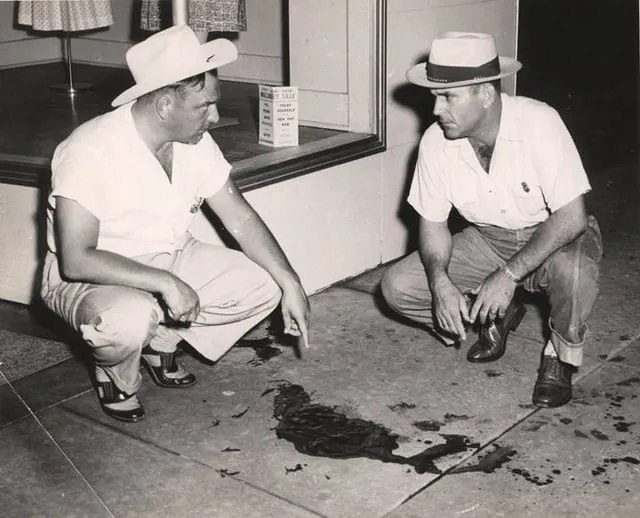
On June 18, 1954, just days after his victory, Patterson was shot three times while getting into his car outside his office. One bullet was fired with the gun pressed against his lips—a symbolic silencing. He stumbled thirty feet before collapsing on the street and dying.
The assassination was the final straw. Alabama Governor Gordon Persons declared martial law. The National Guard moved into Phenix City with orders to dismantle the entire criminal apparatus. Over 1,000 prostitutes fled the city as soldiers raided casinos, destroyed slot machines, and arrested corrupt officials.
Fuller was eventually convicted of first-degree murder and sentenced to prison, though he maintained his innocence. His conviction marked the end of an era—and the beginning of Phenix City’s long, painful climb toward respectability.
The Women History Forgot
Lost in the dramatic narrative of reformers, murders, and military intervention are the women who suffered under Fuller’s system. History records them in aggregate—”over 1,000 prostitutes”—but rarely as individuals with names, stories, and lives destroyed by men with badges and guns.
Some were young women arrested on minor or fabricated charges who found themselves trapped in an impossible situation: work in a brothel or go to jail with a criminal record that would follow them forever. Others were women already vulnerable—poor, pregnant, desperate—who came to Phenix City and found themselves caught in the machine.
The podcast “Infamous America” documented these stories in their Dixie Mafia series, shining a light on how law enforcement didn’t just enable human trafficking—they ran it as a profit center.
The Lessons We Still Haven’t Learned
Phenix City’s story should be a cautionary tale about what happens when law enforcement becomes indistinguishable from organized crime. When the people tasked with protecting the vulnerable become their predators. When badges become a license to exploit rather than serve.
But the lesson is more specific than general corruption. Fuller’s scheme represents something particularly insidious: the weaponization of the criminal justice system against women. Using arrest records, bail requirements, and the threat of incarceration to coerce women into prostitution isn’t an artifact of 1950s Alabama—it’s a pattern that echoes through decades of law enforcement abuse.
Today, Phenix City has rebuilt itself. In 2007, BusinessWeek named it “America’s Best Affordable Suburb for raising a family.” Look magazine once called it an “All-American City.” Portraits of reformer Hugh Bentley and murdered attorney Albert Patterson hang in the municipal building, silent reminders of the city’s dark past and hard-won redemption.
But somewhere in that redemption story, the women deserve more than a footnote. They deserve names, recognition, and a memorial to what was done to them by men who hid behind badges and the law.
Because Chief Deputy Albert Fuller didn’t just run a protection racket. He ran a human trafficking operation with the full backing of local government—and for years, nobody could stop him.
That should terrify us more than any mob story ever could.
Sources
- Alabama Gazette: “Legalized Gambling: Have We Forgotten Phenix City?”
- Crime Capsule: “The Dixie Mafia: The Mob You Never Knew”
- Margaret Anne Barnes, “The Tragedy and Triumph of Phenix City, Alabama”
- Faith Serafin, “Wicked Phenix City”
- Infamous America Podcast, Season 27: “Dixie Mafia: Phenix City” (2023)
- Historic Columbus: “Phenix City: The Triumph”
- Abbeville Institute: “When Good Men Do Nothing”
- Fuller v. State, Supreme Court of Alabama (1959)